When Lightning Strikes Twice: The Yangwang U9 & Xtreme
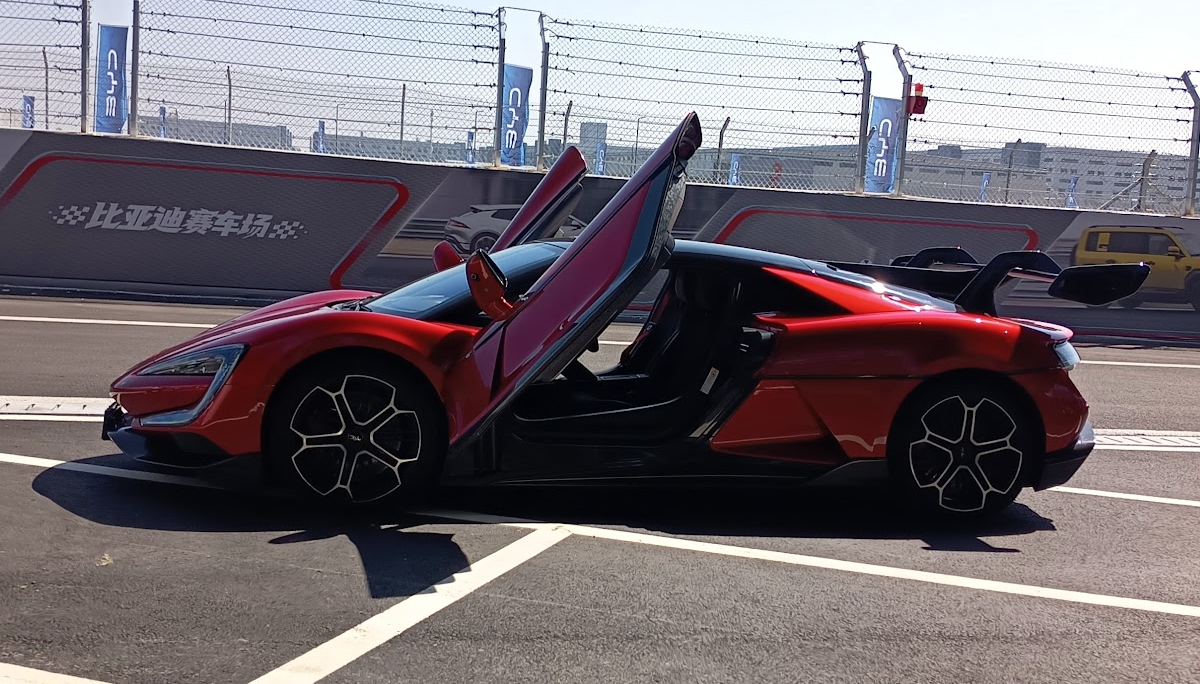
Michael was the English name of our U9 driver at the Zhengzhou All-Terrain Racetrack. He is a young man maybe in his 30s, and spoke like a seasoned GTA driver. He said he was a gamer first, honing his track skills on a Playstation, before real world training and eventually being one of the select U9 test drivers. The proving grounds session in the standard Yangwang U9 was extremely satisfying, electric, and speedy. But after I saw the recording of the U9 Xtreme in its record-breaking performance at the Nürburgring, I knew that Michael was driving at a much slower pace than what the car, in its stock trim, can do. We were only maxing out at about 154 km/hr. “You could go faster, right?” I mused. “We can, but at the moment, we are limited to 154,” Michael said. “Software defined limitation?” I retorted. “No, by memorandum,” he quipped. The scissor doors swing upward like the wings of some predatory insect, and I’m not just entering a car — I’m stepping into a weapon. The carbon-fiber cockpit wraps around me with surgical precision, three massive screens glowing with telemetry data that will soon become very, very relevant. But right now, in this moment of stillness before the storm, all I can think about are the numbers that haunt this machine like ghosts of shattered records. Beneath the sculpted bodywork lies something unprecedented: a 1200V ultra-high-voltage platform, the first of its kind in mass production. Think of it as the nervous system of a apex predator — instantaneous, overwhelming, merciless. Four high-performance electric motors lurk at each corner, screaming to 30,000 rpm when unleashed. Together, they generate over 3,000 PS of raw, unfiltered aggression. Do the math: with a power-to-weight ratio of 1,217 PS per tonne, this isn’t a car anymore — it’s a controlled detonation on wheels. The 0-100 km/h sprint? The standard U9 does it in 2.36 seconds. The Xtreme does it faster, though the official time remains classified. All I know is that when I mash the throttle, reality tears at the edges. The G-force doesn’t push me back—it tries to separate my consciousness from my body. But straight-line speed is theater for the simple-minded. The real story happened elsewhere. One month before its date with destiny at the Nürburgring, the U9 Xtreme rolled onto the runway at ATP Papenburg with one goal: redefine what “fast” means. When the data was verified, the world took notice — 496.22 km/h (308.33 mph), making it the fastest production car on Earth. That’s not a speed. That’s a statement. But here’s what separates the pretenders from the legends: anyone with enough power and a long enough runway can go fast in a straight line. The Nürburgring Nordschleife doesn’t care about your runway. It has 73 corners, 20.832 kilometers of elevation changes, compression zones, blind crests, and a century of humbled egos embedded in its armco barriers. On August 22, 2025, German racing veteran Moritz Kranz strapped into the U9 Xtreme and did what no electric super sports car had ever done: he broke the seven-minute barrier. The Yangwang U9 Xtreme defeated the Bugatti Chiron Super Sport 300+ to become the world’s fastest production car, achieving a top speed of 496.22 km/h (308.4 mph) compared to the Bugatti’s record of 490.48 km/h (304.8 mph). It also surpassed other previous record holders, including the Koenigsegg and Rimac Nevera R, in its record-setting run. Let’s type that down again: 6 minutes, 59.157 seconds. Five seconds faster than the previous record — an eternity at these speeds. And it wasn’t luck or perfect weather or a fluke. It was engineering domination. Do you remember the “futuristic” cars in RoboCop? The 6000SUX? Well, this has nothing to do with it and everything that sounds like it. The SUX wasn’t electric. Some future that was. What allowed the Xtreme to dominate where others merely survived? DiSus-X — the intelligent body-control system that reads the road ahead and adjusts suspension geometry in real-time. On the Nordschleife’s savage elevation changes, it’s not just managing body roll; it’s predicting it, compensating for it, and keeping all four GitiSport e·GTR² PRO semi-slick tires glued to the asphalt with supernatural precision. This isn’t conventional active suspension. This is body-attitude control technology that turns the chassis into a living, breathing organism that adapts faster than human reflexes. To survive thirteen miles of punishment at racing speeds, the Xtreme received comprehensive surgery: Cooling system: Completely redesigned to handle sustained thermal assault. Electric motors generate monstrous heat under continuous load; this system ensures they never flinch. Braking system: New titanium-alloy carbon-ceramic brakes that laugh at brake fade. When you’re scrubbing speed from 300+ km/h repeatedly, ordinary brakes are a death sentence. These are not ordinary. Regenerative braking: Captures energy during deceleration, feeding it back to the track-grade Blade Battery while reducing mechanical brake stress. Efficiency as a performance weapon. Battery architecture: Supporting discharge rates up to 30C, this isn’t just about capacity — it’s about sustained, violent power delivery without thermal collapse. After punishing the car on track, the 1200V platform reveals its final party trick: DC ultra-fast charging at up to 500 kW. That translates to 30% to 80% charge in approximately 10 minutes. You’ll spend more time in the paddock debrief than waiting for electrons. I was told that if you want to build your dream supercar, the Xtreme will be available. Just cough up about RMB 1.8 million (about $250,000++). Only 30 units will ever exist. Thirty. The ‘X’ in Xtreme doesn’t just denote performance — it represents the unknown, the unexplored territory beyond what’s supposed to be possible. Yangwang’s entire philosophy distilled into a limited production run that will become automotive folklore. Badass yer dreams, yeah. The Yangwang U9 isn’t just fast. It’s not just electric. It’s a comprehensive demolition of every excuse that’s ever been made about what battery-powered vehicles can’t do. It holds the top speed crown. It broke the seven-minute barrier at the world’s most demanding circuit. It combines 3,000 PS with intelligence systems that make that power usable, repeatable, and absolutely devastating. This is what happens when engineering ambition meets unlimited determination. This is what happens when a company decides that “impossible” is just another target to obliterate. The scissor doors close behind me, sealing me in the cockpit. The screens glow. The motors hum with barely contained fury. I’m not just riding shotgun anymore. I’m bearing witness to history. CleanTechnica’s Comment Policy Raymond Gregory Tribdino, or Tribs, is an automotive and tech journalist for over two decades, a former car industry executive, and professor with deep roots in the EV space. He was an early contributor to EVWorld.com (1997-1999), was the motoring and technology editor for Malaya Business Insight (www.malaya.com.ph) and now serves as Science and Technology Editor for The Manila Times (www.manilatimes.net), along with co-hosting “TechSabado” and “Today is Tuesday.” He’s passionate about electrification, even electrifying his own motocross bike. Raymond Tribdino has 313 posts and counting.
See all posts by Raymond Tribdino